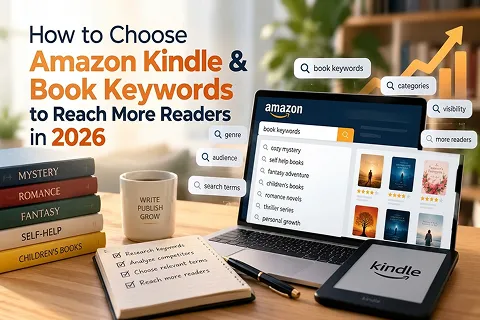
How to Choose Amazon Kindle & Book Keywords to Reach More Readers in 2026
Table of Contents You finished the book. You polished every chapter. Now one question keeps you awake. Will anyone find it? Readers rarely search for
Finishing a manuscript is a big moment. You have taken your idea and done a full draft. But the effort does not stop here.
Your book still requires editing, design, formatting, publication and marketing. Each stage helps prepare it for actual readers.
This book publishing guide tells you what to do next. It covers the major steps without making the procedure seem difficult.
So, if you want to learn how to publish a book, start with what your manuscript needs first.
You may want to edit your manuscript right away. However, a short break can help.
You have spent a long time with your book. Because of this, you may miss weak spots.
So, put the draft aside for a few days or weeks.
Then return with fresh eyes.
For fiction, check the plot, pace, conflict, characters, and ending. For nonfiction, review the chapter order, facts, examples and main ideas.
At this point, do not worry about every comma.
Instead, look at the book as a whole.
Does it flow well?
Are the chapters easy to follow?
These checks give you a better base for the next part of the book publishing process.
Once you return to the draft, begin your self-edit.
First, look for large problems. Each chapter should add something useful. If two sections say the same thing, combine them.
Next, check clarity.
Remove words that do not add value. Also, break long sentences into shorter ones. Then check facts and details. Names, dates, places, headings, and terms should stay the same throughout the book.
A self-edit cannot replace a trained editor. However, it gives your editor a cleaner draft.
As a result, the editor can focus on deeper problems instead of easy fixes.
Professional editing is a key part of a good book publishing guide.
Still, not all editing is the same.
Developmental editing looks at the whole book.
For fiction, it checks plot, pace, characters, conflict, and structure.
For nonfiction, it checks order, logic, missing details, and reader value.
Large changes may happen at this stage.
Line editing works on the writing itself.
It makes the flow, tone, word choice and clarity much better. It can also delete unnecessary or weak words.
However, your voice should still sound like your own.
Copyediting checks the smaller details. It looks at grammar, spelling, punctuation, style, and consistency.
By this point, large changes should already be complete.
Proofreading is the last language check. It finds small mistakes before the book goes live.
For example, it may catch typos, missing marks, extra spaces or layout errors.
Each type of editing has a clear purpose.
Therefore, good editing helps your book feel polished and easy to read.
Give your manuscript the care it needs before design, formatting, and release.
When your manuscript is finished, pick how you want to publish it.
Let your choice be guided by your budget, goals and control.
By the way, traditional publication starts with an agency or publisher.
If your book is accepted, the publisher will take care of editing, design, printing and sales.
But you might have less influence over cover art, price and release date.
It can take a long time as well.
Self-publishing gives you more control.
You can choose your editor, designer, price, format, and release date.
You can also publish through services such as Amazon KDP.
However, you will have more tasks to manage.
For many writers learning how to get a book published, this route can offer a direct path to readers.
Hybrid publishing mixes paid support with parts of traditional publishing.
However, every company works in a different way.
So, check the fees, rights, services, royalties, and contract before you sign.
No one route works for every author.
Choose the one that best fits your plans.
Before you upload your book, collect the key details you will need.
Keep these items ready:
An ISBN gives a book format its own ID.
For example, a paperback and hardcover may need different ISBNs.
Amazon KDP needs an ISBN for many print books. However, Kindle eBooks do not need one. KDP can also offer a free ISBN for some print books.
Copyright is another important point.
The authors can learn about formal registration through the U.S. Copyright Office.
These details may look small. Still, they can affect your book later.
A manuscript holds your words.
However, a published book needs a finished design. Print books need the right margins, trim size, spacing, page numbers, and chapter openings.
E-books need a layout that works on many screen sizes.
Your cover matters too. It should quickly show the book’s tone and genre. Also, the title must stay clear when the cover appears as a small image online.
For print books, the full cover size depends on page count, trim size, and paper type.
Therefore, confirm these details before finishing the cover. Good design does not need to be complex.
Instead, it should make the book clear, clean, and easy to read.
Metadata tells bookstores and search systems what your book is about.
It includes your title, subtitle, description, categories, keywords, and author name. So, do not leave it until the last minute.
Start with your book description. The first lines should catch attention.
To write fiction, focus on the protagonist, situation and stakes. For nonfiction, tell what the reader will learn or solve. Then pick the right categories.
They should match your book closely.
Keywords should also match the words, real readers may search. Do not use unrelated terms only because they are popular.
Good metadata can help the right reader find the right book.
For that reason, it is an important part of this book publishing guide.
Publishing is not only about making a book. Readers also need a place to buy it.
Amazon KDP can make books available through Amazon stores.
However, some authors also want to reach bookshops, schools, or libraries. So, think about where your readers shop.
Then compare print costs, royalties, formats, and store access. Your needs may be simple if Amazon is your main focus.
On the other hand, wider sales may need a broader plan. A clear plan makes the book publishing process for authors much easier to manage.
Still, having a book in stores does not mean people will buy it. You also need to help readers find it.
A screen preview can help. However, a printed proof can show problems you may miss online. If possible, order one before your book goes live.
Check the cover, spine, margins, page numbers, text size, and images.
Also, turn every page.
Look for blank pages, cut text, weak images, or odd page breaks. This check is very important for picture books and other visual books.
Print colors can look different from screen colors. So, correcting problems before release might save you time and preserve the quality of your book.
Don’t wait until the day of release to tell people about your book. Instead, begin marketing today, while the book is still in print. Build your author website, social media posts and email list. Advance reader copies might also assist you start to get reviews and feedback early.
You can also utilize guest blogs, interviews, launch graphics, or book trailers. But you don’t need every marketing method. Pick the channels that match your readers and your genre.
For example, a children’s author may use different platforms than a business writer. A focused plan is easier to manage and often works better.
After launch, keep collecting reviews and testing your marketing so new readers can continue to find your book.
Many authors manage parts of publishing on their own. However, editing, design, formatting, metadata, and release tasks can take time. Professional author publishing services can help bring these parts together.
Next Chapter Publishings supports authors who want a smoother path from finished manuscript to professional release while staying involved in key decisions.
Learning how to publish a book becomes easier when you know what comes after writing. Each stage has a clear purpose, from preparing the manuscript to planning the release. A useful book publishing guide should make those choices easier to understand.
Next Chapter Publishings can help authors turn finished manuscripts into polished, ready-to-publish books while keeping the process clear and professional.
Turn your finished manuscript into a professionally published book with expert support.
Leave the draft for a while. Then edit for structure, flow, clarity and details, then do the professional editing.
Professional editing can enhance clarity, flow, grammar and consistency. It can also discover problems you might miss yourself when you edit.
Yes. Publishing help might be editing, design, formatting, setup, and more. Always check to see what your chosen service offers.
Yes. Expert support can help handle technological chores and minimize blunders. So you can spend more time writing your book.
Next Chapter Publishings can support key publishing tasks and help prepare your manuscript for a polished, professional release.
Recent Post
Table of Contents You finished the book. You polished every chapter. Now one question keeps you awake. Will anyone find it? Readers rarely search for

Table of Contents Imagine your book sitting on a shelf where no one looks. The cover looks great. The story is strong. You spent months

Table of Contents Publishing your book can feel like reaching the finish line. Yet when a reader finds that book on Amazon, another important journey